
In the cold heading of screws, bolts, and various fasteners, internal hex formation has always been a critical process step.
Especially when machining high-strength steel, stainless steel, and deep internal hex products, conventional fixed internal hex punches are prone to issues such as chipping, accelerated wear, and even breakage.
To address this, an increasing number of cold heading machines are adopting rotary internal hex punch technology.
Many people believe that the principle behind rotary punches is similar to drilling, but this understanding is actually inaccurate.
Rotary hex punches do not rely on high-speed rotation for cutting; rather, while being pressed axially into the workpiece, they rotate at low speed according to a preset angle.
This causes the material to undergo plastic deformation more uniformly and gradually, thereby reducing punching force and extending punch life.
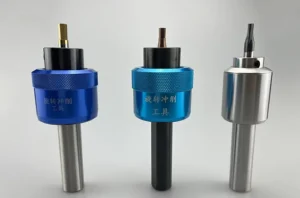
Why Do Conventional Hex Punches Fail Easily?
When a traditional fixed punch enters the workpiece, all six edges come into contact with the material simultaneously.
Since the entire hexagonal contour must be plastically formed within an extremely short time, the punch is subjected to extremely high instantaneous loads.
When the material is high-strength steel (Grades 10.9 or 12.9) or stainless steel (such as 304 or 316), the material’s resistance to deformation increases significantly, leading to severe stress concentration at the six sharp corners.
At the same time, material flow is restricted, causing friction and heat generation to rise rapidly, which makes the punch more prone to chipping, cracking, and fatigue failure.
Therefore, the service life of a fixed punch is typically influenced by three factors: peak load, localized stress, and frictional wear.
True Working Principle of the Rotating Hexagonal Punch
The core concept of the rotating hexagonal punch is to break down the hexagonal forming process—which would otherwise be completed in a single step—into a series of continuous, incremental local forming processes.
As the punch presses downward into the material, its body rotates slowly through a small angle.
Due to this rotational motion, the six edges do not enter the material simultaneously but instead participate in plastic deformation sequentially in a specific order.
This processing method is analogous to converting a single, concentrated force application into a continuous, moving force process.
The material does not undergo instantaneous deformation across the entire hexagonal contour but gradually forms the final hexagonal shape as the punch rotates.
Consequently, the entire forming process is smoother, and impact loads are significantly reduced.
Why Does Rotation Reduce Punching Force?
Cold heading is essentially a plastic forming process rather than a cutting process; therefore, the state of material flow determines the magnitude of forming resistance.
When a fixed punch is pressed into the material, it must simultaneously induce plastic deformation across the entire hexagonal area.
Since a large volume of material undergoes deformation per unit time, a higher forming force is required.
With a rotating punch, material flow begins in a localized area. As the punch continues to rotate, the area of plastic deformation gradually expands until the entire hexagon is fully formed.
Since the material deformation is distributed throughout the entire rotation process, the deformation resistance that must be overcome at any given moment is significantly reduced.
Extensive practical production experience shows that, compared to fixed punches, rotating punches typically reduce peak punching force by approximately 10% to 30%.
This advantage is even more pronounced when machining high-strength materials.
More Uniform Material Flow
Rotational motion not only alters the force application but also changes the material’s flow path.
When machining with a fixed punch, the material must flow in multiple directions simultaneously, making it prone to localized blockages.
This can result in insufficient metal filling or stress concentration, ultimately affecting the dimensions and surface quality of the internal hexagon.
In contrast, a rotating punch continuously changes its contact position, allowing the material to flow gradually along the punch’s contour at all times, enabling the metal to fill the corners of the hexagon more smoothly.
This more uniform plastic flow typically results in a more complete hexagonal contour, better dimensional consistency, and a lower burr rate, while also reducing cracks and folding defects caused by uneven material flow.
Friction and Temperature Rise Are Also Reduced
During processing with a fixed punch, high-pressure sliding friction continuously occurs at the same point on the workpiece, causing significant heat to build up in the contact area.
As the temperature rises, the lubricating film is prone to failure, and the material may even stick to the die, further exacerbating punch wear.
With a rotating punch, the contact area constantly changes, so no single point is subjected to friction for an extended period, resulting in significantly reduced frictional heat per unit area.
Although sliding friction still occurs, it is more dispersed, and lubrication conditions are easier to maintain.
This characteristic is particularly important for materials prone to sticking to the die, such as stainless steel and titanium alloys.
More Rational Stress Distribution
Punch failure is typically not caused by insufficient overall strength, but rather by fatigue failure resulting from excessive local stress.
The six sharp corners of a fixed punch are subjected to the highest loads over the long term, causing stress to concentrate at the same locations consistently.
After numerous cycles, microcracks are likely to form, ultimately leading to corner chipping or fracture.
Rotating punches, on the other hand, cause the high-stress areas to constantly shift, allowing the six edges to bear the load in turn, so that no single location remains under maximum stress for an extended period.
This dynamic load distribution significantly reduces fatigue damage and extends the service life of the punch.
Consequently, in continuous high-volume production, the service life of a rotating punch is typically 1.5 to 3 times that of a conventional punch, and under certain operating conditions, it can even be several times longer.
How is the rotational motion achieved?
The rotating hexagonal punch does not rotate on its own; instead, it relies on the machine’s mechanism to convert axial motion into rotational motion.
Currently, the most common method in industrial applications involves incorporating helical guide grooves inside the punch holder.
As the punch is pressed downward axially, the guide grooves drive the punch to rotate synchronously, enabling stable and repeatable angular control.
This mechanism is simple in structure and relatively low in cost, making it the most widely used in cold heading equipment.
For high-speed automatic cold heading machines, a cam mechanism can also be used to control the punch’s rotation angle and cycle time to meet high-speed production demands.
In recent years, some high-end cold heading equipment has begun adopting servo drive systems.
These systems use motors to precisely control the punch’s rotation angle, speed, and direction, ensuring optimal forming results for products of various specifications.
Advantages of Rotating Hex Socket Punches
The greatest advantage of rotating hex socket punches does not lie in rotation alone, but in how rotation alters the material’s plastic flow behavior and stress distribution.
Reduced peak punching force, more uniform material flow, decreased friction and heat generation, and alleviated stress concentration—these factors collectively improve the quality of hex socket forming and significantly extend punch life.
For the production of high-strength screws, stainless steel fasteners, deep internal hex products, and other difficult-to-form parts, rotating internal hex punches have become a key technical solution for improving production efficiency and reducing manufacturing costs in modern cold heading processes.
Conclusion
The machining principle of the rotating internal hexagonal punch does not rely on high-speed rotation to cut material, but rather introduces controlled, low-speed rotation during the axial pressing process, transforming what would otherwise be a single-step hexagonal forming operation into a continuous, gradual plastic deformation process.
This machining method effectively improves the material flow state, reduces instantaneous forming forces, and alleviates stress concentration and frictional wear on the punch.
As the material gradually fills the internal hexagon contour, the forming process becomes smoother, not only improving the dimensional accuracy and surface quality of the internal hexagon but also significantly reducing common issues such as corner chipping, cracking, and die sticking.
These advantages are particularly evident for high-strength steel, stainless steel, and other difficult-to-form materials, typically extending punch life and enhancing production stability.
As cold heading equipment evolves toward higher speeds, greater intelligence, and higher precision, rotating hexagon punch technology has become a key technique in the manufacturing of high-end fasteners.
For manufacturers seeking higher production efficiency, longer die life, and more consistent product quality, the proper application of rotating hexagon punch technology not only helps reduce production costs but also enhances overall manufacturing competitiveness.