
The global climate crisis worsens, and resource and environmental pressure keeps rising. Green and low-carbon development now shapes international industrial competition and collaboration.
The Fourth Plenary Session of the 20th Central Committee sets this direction. It takes carbon peaking and carbon neutrality as a key driver.
The policy coordinates carbon cuts, pollution control, ecological restoration and economic growth. It builds a robust ecological security barrier and fuels green development.
Ecological innovation balances economic gains and environmental outcomes. It guides manufacturing toward a far-reaching shift to sustainable modes.
Today, numerous manufacturing enterprises are actively putting the concept of green development into practice and taking the initiative to engage in green innovation.
China National Building Materials Group has issued green and sci-tech innovation medium-term notes totaling 4 billion yuan.
These funds back green building material research and emission-reduction technology promotion. Fotile Group adopts the “dual-fan series connection + integrated top exhaust” solution.
This technology optimizes the airflow layout inside ventilation ducts. Product energy efficiency and smoke exhaust performance improve simultaneously.
Nevertheless, ecological innovation among Chinese manufacturing enterprises still has shortcomings. Green and low-carbon patents in China see fast growth in quantity.
Yet enterprises hold too few high-value green patents. A gap still exists against developed economies. The disparity lies in patent industrialization and practical deployment.
Therefore, how to enhance the level of ecological innovation has become a common challenge facing Chinese manufacturing enterprises.
Supply Chain Integration as An Enabler for Eco-Innovation
Supply chain integration is considered a key measure for achieving eco-innovation. Eco-innovation covers new materials, processes and management methods.
This work is a systematic, cross-organizational initiative.A single firm rarely owns enough resources and capacity to finish it alone.
Supply-wide resource integration becomes an urgent requirement. In fact, some companies have already taken corresponding actions.
For example, Apple has achieved closed-loop management of carbon emissions across its supply chain by mandating uniform clean energy standards and data interfaces;
Nestlé has achieved standardized integration of energy consumption across the entire supply chain by building its own digital platform and requiring logistics partners to connect to it.
However, many companies still face practical challenges—such as inconsistent data standards and inaccurate forecasts—as they advance this integration.
For instance, Walmart and some suppliers experienced settlement disputes due to differing sales data standards, ultimately leading to the termination of their partnership;
Procter & Gamble suffered severe discrepancies between its demand forecasts and actual demand due to the “bullwhip effect,” resulting in significant waste of resources.
It is therefore evident that effectively promoting the deep integration of manufacturing supply chains is a matter of urgency.
Artificial Intelligence Driving Supply Chain Integration
The application of artificial intelligence has become a key driver of supply chain integration. With its powerful data storage and processing capabilities, AI plays a vital role in areas such as precise forecasting, real-time monitoring, and dynamic scheduling.
An increasing number of manufacturing companies are widely adopting AI in their supply chain practices.
For example, Haier uses AI forecasting models to integrate sales and production planning data, thereby achieving efficient cross-departmental integration;
Foxconn employs an AI-powered visualization system to conduct comprehensive monitoring of production operations, integrating dispersed supply chain links into a unified decision-making system;
SanGang Group has leveraged AI technology to establish a standardized big data platform, effectively reducing the extent of data silos within the enterprise.
Therefore, promoting the application of AI technology is of paramount importance.
Research Gaps and Research Framework of This Study
Existing research treats artificial intelligence as a technical enabler for eco-innovation. Other papers examine the direct connection between supply chain integration and eco-innovation.
Few scholars combine these three variables within one unified analytical framework. Therefore, this study examines 227 Chinese manufacturing firms.
This study draws on technology enablement and organizational capability theories. It empirically explores how artificial intelligence shapes supply chain integration and eco-innovation.
The findings lay a theoretical foundation for manufacturing enterprises. They offer actionable guidance for firms to deploy AI. These companies can strengthen supply chain integration and advance eco-innovation.
Literature Review and Research Hypotheses
Literature Review
1. Definition and Classification of Artificial Intelligence Applications
Minsky was among the first to define artificial intelligence as enabling machines to perform tasks that typically require human intelligence.
Since then, the applications of artificial intelligence have gradually expanded into a new technology deeply integrated with big data.
Currently, there are two primary perspectives on categorizing the dimensions of artificial intelligence applications.
First, based on the level of intelligence, applications can be divided into three categories: strong artificial intelligence, weak artificial intelligence, and superintelligence.
Second, based on functional orientation, they can be categorized into areas such as cognitive formation, task simplification, and interpersonal interaction.
At the same time, artificial intelligence applications help enhance employee well-being, promote corporate innovation, and improve supply chain efficiency.
This paper follows the definition put forward by Yu et al. AI applications represent technical practices for organizations.
Intelligent algorithms support efficient information processing. Organizations use this information to boost their capacity for targeted tasks.
Furthermore, this study categorizes AI applications into three dimensions: cognitive formation, task simplification, and interpersonal interaction.
2. Definition and Classification of Supply Chain Integration
Supply chain integration unites processes and information with upstream and downstream partners. Close collaborative ties lift the overall efficiency of the supply chain.
Scholars adopt two mainstream classification schemes for its dimensions. The first scheme follows integration scope: internal integration, supplier integration, and customer integration.
The second scheme centers on collaboration content. It includes information sharing, synchronized planning, operational coordination, and strategic partnerships.
Existing research indicates that information technology, cloud computing, human capital, and business models can all significantly enhance the level of supply chain integration.
Furthermore, supply chain integration plays a positive role in improving supply chain performance and operational performance, as well as in driving green innovation and technological innovation.
This paper adopts the definition from Liu et al. Supply chain integration acts as one type of strategic capability. Enterprises coordinate with channel partners and allocate resources.
These efforts create synergistic benefits. This study splits the construct into two dimensions: information sharing and operational coordination.
3. Definition and Classification of Eco-Innovation
Eco-innovation refers to innovative activities that integrate the concept of sustainable development into products, production processes, organizational structures, and business models.
Its purpose is to achieve economic benefits while reducing negative environmental impacts and improving resource utilization efficiency.
The academic community typically categorizes it into three dimensions: green product innovation, green technology innovation, and green management innovation.
Two tiers shape ecological innovation. Internal firm capabilities cover green capabilities and absorptive capacity. External drivers include environmental rules, market pressure and social norms.
This study follows the work of Cheng et al. Ecological innovation creates both environmental and economic gains. It relies on innovations for products, production processes or business models.
The paper divides it into ecological management innovation and ecological product innovation.
Research Hypotheses
The theory of technology enablement suggests that advanced technologies can endow organizations with new capabilities for action and mechanisms for change.
Based on this, artificial intelligence can effectively promote integration within supply chains and among partners.
At the same time, based on organizational capability theory, supply chain integration itself can be viewed as a core capability.
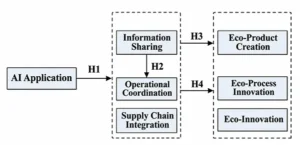
Advanced AI technologies can drive the development of supply chain integration capabilities, which in turn provides crucial support for ecosystem innovation practices.
To this end, this paper constructs a conceptual framework of “AI Application → Supply Chain Integration → Ecosystem Innovation,” as shown in Figure 1.
1. The Impact of Artificial Intelligence Applications on Supply Chain Integration
Artificial intelligence applications have created favorable conditions for information sharing within the supply chain.
First, artificial intelligence technology can connect various nodes in the supply chain, forming a closely coordinated network that enhances the accuracy of information transmission.
Second, advancements in AI technology have significantly reduced information processing costs, increased information storage capacity, and accelerated the speed of information dissemination.
This has broken down the temporal and spatial constraints on information collection and utilization, effectively ensuring the security and reliability of information transmission.
Furthermore, large language models based on AI can learn and optimize based on user-input information, achieving “alignment” between the AI model’s expressions and intrinsic value and human common sense and values.
They can also utilize prompt tuning techniques to more precisely align with users’ language habits and communication styles, helping users gain a deeper understanding of issues. AI technology can also drive operational coordination within the supply chain.
First, advanced AI technology empowers the whole supply chain.
It supports full lifecycle control over production, procurement and warehousing. The tool facilitates collaboration across core value-chain activities. It helps enterprises capture, organize and distribute information resources.
Second, the application of AI and machine learning technologies can automate decision-making processes, thereby accelerating decision-making and improving accuracy.
Machine learning algorithms analyze historical sales records. These algorithms calculate suitable inventory thresholds automatically. The results avoid overstock and stockout risks.
Human error ranks among the main error sources in conventional supply chain management. Artificial intelligence cuts manual intervention in daily operations. This change reduces overall error rates.
Therefore, this paper proposes the following hypotheses:
The application of artificial intelligence has a positive impact on information sharing. The application of artificial intelligence has a positive impact on operational coordination.
2. Internal Relationships in Supply Chain Integration
Information sharing helps improve operational coordination within the supply chain. High-quality information sharing removes internal and external information barriers for enterprises.
It synchronizes production, inventory, sales and other data in real time. Feng Hua and co-authors note the value of information sharing. It lessens information distortion during data transmission.
This control curbs demand errors and economic losses from the bullwhip effect. The practice optimizes coordinated resource allocation across the supply chain network.
Luo Chunlin and other researchers analyze demand data from e-commerce platforms. Their results show more accurate platform demand information brings greater economic returns.
Enterprises capture these gains via information sharing. Ongoing communication connects upstream and downstream partners. Partners keep updated on each other’s operational status. This interaction builds solid trust between them.
All participants coordinate and cooperate more willingly. These efforts make supply chain operations run more smoothly.
Therefore, this paper proposes the following hypothesis:
Information sharing has a positive impact on operational coordination.
3. The Impact of Supply Chain Integration on Ecological Innovation
(1) The Impact of Information Sharing on Ecological Product Innovation
Information sharing supports ecological product innovation. Yu Fei and his co-authors observe a limitation for firms.
Firms struggle to advance green technological innovation with isolated expertise. Information thus serves as a critical breakthrough point.
First, environmental information such as “carbon footprint” and “carbon decision-making” enables effective management of green, circular resources across the entire value chain.
This outcome raises firms’ willingness and ability to join environmental governance voluntarily. It pushes forward energy saving, emission cuts and green innovation.
Better internal information processing supports coordinated product design. Teams develop high-value, high-efficiency products to match customer demands.
Li Jingjing and her co-authors highlight the benefit-sharing mechanism. This mechanism motivates supply-chain enterprises to pursue eco-product design and green innovation.
Information sharing also mitigates investor resource shortages from information asymmetry. It reshapes green innovation investment within the supply chain.
The final end products achieve stronger environmental performance. Information sharing can effectively promote innovation in ecological management.
As enterprises’ digital capabilities continue to improve, information sharing has become increasingly commonplace. This practice eases information constraints for enterprises.
Greater transparency of environmental information improves corporate commercial credibility. These conditions lay the foundation for sustainable green management.
Dai and other scholars study environmental management in supply chains. Successful green management builds cooperative ties with supply chain partners.
Frequent communication helps firms acquire resources to carry out green plans. Huo and his team reach another conclusion. Active information sharing with core partners clarifies shared environmental targets.
All members accept these common goals more readily. Information exchange with suppliers and customers shortens product development cycles.
It boosts corporate responsiveness. The approach cuts uncertainty and decision errors during eco innovation.
Therefore, this paper proposes the following hypotheses:
Information sharing has a positive impact on ecological product innovation. Information sharing has a positive impact on ecological management innovation.
(2) The Impact of Supply Chain Integration on Ecological Management Innovation
① Effects of Operational Coordination on Ecological Product Innovation
Operational coordination also promotes the innovation of ecological products.
The theory of co-creation of value suggests that value is not created and provided unilaterally by a company, but rather through the joint participation of the company and its customers.
Operational coordination brings diverse stakeholders together on one broader interaction platform. It helps supply chain participants optimize their decision-making context.
The coordination also designs incentive mechanisms. These mechanisms guide consumers to select innovative green products.
Chen Yi and other researchers confirm the value of effective operational coordination. It cuts costs for green investment and AI driven digital marketing.
Consumers become more responsive to green products and these marketing campaigns. Supply chain members gain higher profits on online platforms. Their products achieve stronger green attributes at the same time.
Efficient operational coordination improves organizational responsiveness. Organizations can react fast to emerging challenges.
These challenges include updated environmental regulations and changing consumer preferences. Both changes stem from shifts in the external environment.
Teams then design innovative eco-friendly products that meet regulatory requirements.
② Effects of Operational Coordination on Ecological Management Innovation
Operational coordination also contributes to innovation in ecological management. Operational coordination advances resource sharing and benefit allocation.
It also reinforces risk-sharing arrangements across participants. These steps lift the ecosystem’s capacity for risk governance and green operation.
Boundary-spanning innovation and co-value creation follow from this work. The ecosystem reaches high-quality supply chain management.
Supply chain partners serve as an important source of innovation. Operational coordination unlocks spillover effects more completely.
Partners generate synergies with one another. Enterprises hit ecological targets like carbon reduction and zero waste with higher efficiency.
Operational coordination fosters a long-term mindset across the supply chain network. It pushes firms to prioritize sustained growth and sustainable competitive edges.
These priorities guide their green supply chain management practices. As a result, enterprises invest more resources in environmental protection and green innovation.
③ Research Hypotheses
Therefore, this paper proposes the following hypotheses:
Operational coordination has a positive impact on ecological product innovation. Operational coordination has a positive impact on ecological management innovation.
Research Methodology
Research Sample and Data Collection
This research targets manufacturing firms in China.
It samples enterprises from Beijing-Tianjin-Hebei, the Yangtze River Delta, the Pearl River Delta, and central and western China.
The sample covers regions at different economic development levels. Smaller enterprises struggle with tight resources and immature management systems.
These constraints hinder complex supply chain work and advanced collaborative innovation. For this reason, the study restricts its sample to manufacturers with over 100 employees.
Mid- to senior-level managers were selected as respondents to ensure an accurate reflection of corporate operations.
A total of 278 questionnaires were distributed for this survey. After excluding invalid questionnaires due to missing information or repetitive responses, 227 valid questionnaires were obtained, resulting in a valid response rate of approximately 81.7%.
As shown in Table 1, the geographical distribution of the surveyed enterprises is relatively even.
The electronics and electrical appliances, as well as the metal, machinery, and engineering industries, account for nearly 60% of the total.
Private enterprises predominate, with more than 90% of the enterprises having over 300 employees, and the majority having been in operation for more than ten years.
Table 2 indicates that more than 90% of the respondents have been in their current positions for at least three years and are well-informed about the enterprises’ operations.
Variable Measurement
All measurement items for the variables in this study were adapted from existing literature.
With the exception of basic company information, all other items were measured using a 5-point Likert scale.
1. Artificial Intelligence Applications.
We follow the scale developed by Yu et al. Respondents rate their firm’s AI application performance along three dimensions.
These dimensions are cognitive formation, task simplification, and interpersonal interaction. Cognitive formation contains three measurement items.
It merges multi-source data and applies advanced algorithms for decision support. It breaks down information to locate underlying root causes.
Task simplification also includes three items. The system adapts quickly to changes and unites cross-departmental data.
It supports smooth human-system collaboration. Interpersonal interaction covers three items as well.
It boosts cooperation among employees and improves customer engagement. It optimizes collaboration with suppliers.
2. Supply Chain Integration.
Drawing on the research by Liu et al., respondents were asked to evaluate the implementation of the company’s supply chain integration activities based on two dimensions: information sharing and operational coordination.
Specifically, information sharing comprises three items: mutual notification of impactful events, timely information exchange, and regular exchange of delivery schedules;
Operational coordination comprises three items: coordination of business activities, coordination of order fulfillment, and coordination of service support.
3. Ecological Innovation.
Drawing on the research by Cheng et al., respondents were asked to evaluate the company’s performance in ecological innovation based on two dimensions: ecological product innovation and ecological management innovation.
Ecological product innovation comprises three items: simplifying product structure, reducing production waste, and reducing production pollution;
Ecological management innovation comprises three items: high R&D investment, voluntary compliance with environmental regulations, and interdepartmental exchange of ecological innovation experiences.
Empirical Testing and Analysis of Results
Reliability and Validity Testing of the Questionnaire
As shown in Table 3, the Cronbach’s α values for all variables are greater than 0.8, indicating that the scale has high reliability.
The validity analysis covers content validity, convergent validity, and discriminant validity.
First, since all questionnaire items are derived from well-established scales, content validity is ensured.
Second, tables 3 and 4 report the validity test results. Every item has a factor loading well above 0.5.The AVE of each variable exceeds the threshold of 0.5.
The square root of each AVE surpasses its correlation coefficients with other variables. These results confirm satisfactory convergent validity and discriminant validity of this scale. In summary, the measurement model demonstrates good reliability and validity.
Structural Model
This study utilized AMOS 28.0 software to test the hypotheses through structural equation modeling.
As shown in Table 5, all model fit parameters met the criteria, indicating good model fit; the model is therefore acceptable.
Figure 2 illustrates these results. Artificial intelligence application exerts positive effects on information sharing and operational coordination.
The evidence supports Hypotheses H1a and H1b. Information sharing positively predicts operational coordination.
This outcome validates Hypothesis H2. Information sharing drives ecological product innovation and ecological management innovation.
The findings confirm Hypotheses H3a and H3b.
Operational coordination also has a positive impact on both ecological product innovation and ecological management innovation, confirming Hypotheses H4a and H4b.
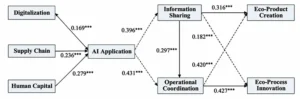
Table 6 presents the indirect effect results. AI applications shape ecological product and management innovation through information sharing and operational coordination.
All corresponding 95% confidence intervals exclude zero. This finding proves supply chain integration acts as a mediator between AI applications and eco-innovation.
A similar transmission path exists inside supply chain integration. AI applications affect operational coordination indirectly via information sharing.
The 95% confidence interval for this path also does not contain zero. Information sharing mediates the influence of AI applications on operational coordination.
表6
Conclusions, Implications, and Outlook
Main Conclusions
This study examines 227 Chinese manufacturing firms. This paper empirically examines the links among AI adoption, supply chain integration and eco-innovation.
AI adoption lifts the overall level of supply chain integration. This integration further facilitates eco-innovation outcomes.
The study places these three constructs within one unified analytical framework. It uncovers a structural path: technology adoption → resource coordination → green innovation.
Theoretical Contributions
1. Factor Structure Characteristics of Artificial Intelligence Applications
First, the application of artificial intelligence exhibits a three-dimensional factor structure, with varying loadings across each dimension.
Among these, the loading related to “cognitive formation” is the highest.
This may be because the mindset of using data to solve problems—facilitated by AI technology—is crucial, as it can effectively deepen an enterprise’s understanding and enhance its innovation capabilities.
Technology-enabled empowerment theory explains the core value of AI. AI reshapes the organizational cognitive framework and decision-making logic.
Cognitive formation serves as a direct manifestation of this enabling mechanism. The load associated with interpersonal interaction ranks second, while that associated with task simplification is the smallest.
This may indicate that, at the current stage, enterprises are more focused on the decision-making and collaborative value of AI rather than merely pursuing task-simplification functions.
Organizational capability theory distinguishes these two mechanisms. Task simplification belongs to operational capabilities and can be substituted easily.
Interpersonal interaction reflects collaborative capabilities. This capability proves hard for competitors to copy. It delivers more notable benefits accordingly.
2. Influence of Artificial Intelligence Applications on Supply Chain Integration
Second, AI applications can promote supply chain integration, with their impact on information sharing being particularly notable.
From the perspective of technology-enabled theory, AI’s core advantage lies in its powerful information processing capabilities, which align closely with the technical attributes of information sharing.
With the help of AI technology, enterprises can rapidly collect and integrate data from all links in the supply chain, making information transmission more timely and comprehensive;
Operational coordination, however, is easily constrained by non-technical factors such as organizational culture and the distribution of interests, and is thus relatively less directly influenced by AI.
Nevertheless, high-quality information processed by AI technology can help enterprises quickly filter out useful data during operations, ultimately enhancing the overall effectiveness of supply chain integration.
From the perspective of organizational capability theory, capabilities are hierarchical.
Information sharing is a foundational capability, while operational coordination is an advanced capability.
The application of AI can strengthen the information foundation and, by enhancing foundational capabilities, drive improvements in advanced capabilities.
Therefore, the application of AI can influence operational coordination through information sharing.
3. Differentiated Effects of Supply Chain Integration on Ecological Innovation
Finally, supply chain integration helps raise the level of ecological innovation.
Among these, operational coordination has a more pronounced impact on ecological product innovation, while information sharing plays a more significant role in ecological management innovation.
Operational coordination supports product compliance with environmental standards. It fosters efficient cooperation with upstream and downstream partners.
The team allocates resources centrally and rolls out upgrades quickly. Typical measures include green material adoption and clean process deployment.
Information sharing keeps firms updated on policy updates, carbon emission data and market shifts. These inputs guide more scientific energy-saving and carbon-reduction plans. Both internal and external collaboration capabilities get strengthened.
Lessons from Practice
First, based on the three-dimensional framework of artificial intelligence, companies can adopt differentiated implementation strategies to enhance their sustainable competitiveness.
Firms use AI analytics tools to interpret green policies and market trends. This deepens their strategic understanding of eco innovation.
Automation handles repetitive workflows for task simplification. The move releases staff from monotonous work.
Enterprises redirect these human resources to high-value tasks. Examples include eco-product research and low-carbon process optimization.
Intelligent collaboration platforms support interpersonal interaction. These platforms aggregate cross-departmental data. Simulation models depict supply chain carbon flow and shifting market demand.
Organizations gain faster response and stronger resource integration.
Second, manufacturing enterprises must enhance their supply chain integration capabilities to achieve ecological innovation.
First, by leveraging a unified data platform and establishing clear data standards, they can share key information—such as material composition and carbon emissions data—with core partners.
This breaks down information silos within the enterprise and provides a data foundation for green management throughout the product’s entire life cycle.
Second, environmental performance can be incorporated as a mandatory criterion in supplier selection.
Firms offer technical guidance, green certifications, and long-term contracts.
These measures motivate suppliers to lift their environmental standards.
Raw materials and components come from green sources. Supply chain innovation costs and benefits are shared collectively.
Limitations and Outlook
This study has certain limitations.
First, the sample primarily focuses on the manufacturing sector; in the future, the generalizability of the findings could be enhanced by expanding the scope of the survey and increasing the sample size.
Second, the application of artificial intelligence may also influence ecological innovation through other channels, such as knowledge management and organizational learning.
Knowledge management turns information into innovation resources.
Organizational learning focuses on absorbing and applying technologies.
Future studies may dig deeper into how AI applications affect eco-innovation.
Many contextual factors can alter the above relationships.
Organizational culture theory holds that green culture shapes firms’ environmental values and behavioral tendencies.
It may amplify the effect of supply chain integration on eco-innovation.
Dynamic capabilities theory offers another perspective. Firms need flexible strategies and resource arrangement under high environmental uncertainty.
Organizational green culture and environmental uncertainty may serve as moderators.
Scholars can add these two variables into models for subsequent verification.