
Aluminum-based materials rank among the most widely used materials.
Among these materials, aluminum alloys are widely used in consumer electronics.
They are also extensively applied in electronic circuits, such as aluminum substrates.
In addition, they play an important role in precision components.
Manufacturers favor aluminum alloys because they offer excellent thermal conductivity.
They have low density and high strength. They also provide good formability and superior resistance to oxidation and corrosion.
Typical applications in consumer electronics include:
Enclosures and frames for portable devices like smartphones, laptops, and smart wearables.
Thermal management components such as heat sinks, fins, and heat pipes.
Mounting brackets or fasteners for electronic components; – Battery casings.
Hinges are critical components in foldable phones and tablets. Manufacturers typically produce these parts from aluminum alloys to achieve lightweight structures and high strength.
Drilling aluminum alloys for consumer electronics is a key manufacturing process.
This operation must meet extremely strict quality requirements. The hole dimensional accuracy usually requires tolerances below ±0.01 mm.
The process must also ensure high hole perpendicularity.
In addition, manufacturers must maintain excellent hole wall quality and completely burr-free edges.
Processing quality significantly impacts both product functionality and appearance.
In the electronic circuit field, aluminum-based printed circuit boards, commonly referred to as aluminum substrates, are widely used in many industries.
Engineers apply them extensively in LED lighting systems and power electronics.
They are also used in automotive electronics, base station antennas, and RF modules.
In addition, they play important roles in solar cells, industrial control instruments, aerospace systems, and radar equipment.
Industries favor aluminum substrates because they provide excellent thermal conductivity.
They also offer effective electromagnetic shielding and high mechanical strength.
Milling of aluminum substrates requires burr-free edges and extremely tight dimensional tolerances.
Mechanical drilling and forming processes are critical for ensuring dimensional accuracy and surface finish quality, directly determining the stability and service life of aluminum alloys during operation.
Due to aluminum’s low hardness and chemically active nature, it readily adheres to drill and milling cutter edges during machining.
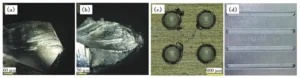
This increases cutting forces, hinders chip evacuation, and often leads to poor dimensional accuracy, degraded surface finish, severe burrs at hole edges and panel edges, and even tool breakage risks, as shown in Figure 1.
Cemented carbide serves as a common substrate material for drilling and milling tools in machining.
It possesses excellent properties including high hardness, wear resistance, good strength and toughness, high-temperature resistance, and corrosion resistance.
However, when machining aluminum alloys, cemented carbide tools frequently encounter issues such as tool adhesion, chip entanglement, tool breakage, burrs at hole openings, and burrs along plate edges.
The primary cause lies in the high friction coefficient of cemented carbide. Aluminum chips readily adhere to the tool edge or spiral flutes, hindering smooth chip evacuation.
This compromises tool sharpness, increases cutting forces, and intensifies the pulling effect on the aluminum material.
Optimizing the properties of cemented carbide materials can reduce its friction coefficient to around 0.6, yet this remains relatively high and fails to resolve issues like tool adhesion and chip evacuation difficulties.
Physical vapor deposition (PVD) technology enables tailored optimization of tool surface properties by designing coating composition, structure, and performance according to specific machining scenarios and requirements.
This achieves reduced friction coefficients and diminished chemical reactivity on the cemented carbide surface.
Dasch evaluated the drilling life under dry cutting conditions by applying metal-doped diamond-like carbon (DLC), hydrogen-containing DLC, graphite, and diamond coatings to a 6.35 mm diameter drill bit.
Results showed the hydrogen-containing DLC coating achieved a processing life of 912 holes, outperforming other PVD/PECVD coatings.
Silva demonstrated that DLC coatings on 7.5 mm micro-drill bits significantly enhance hole quality.
Tsao investigated the effect of TiAlN coatings on aluminum alloy machining performance.
The results showed that, compared with uncoated carbide end mills (6 mm cutting diameter), TiAlN-coated tools reduced cutting forces by 10%.
The coating also decreased rake-face wear by 38.7%.
Subhedar further investigated the influence of TiN coatings on cutting forces and milling quality during aluminum alloy machining.
Findings revealed that TiN-coated milling cutters reduced cutting forces by 30% compared to uncoated cutters, while also achieving superior surface roughness on machined workpieces.
Most of the above studies focused on large-sized tools (6 mm).
However, when drill or milling cutter sizes decrease, tool breakage and chip evacuation behavior become critical factors affecting the drilling and milling of aluminum-based materials.
Currently, there is limited research on the influence of micro-drills, micro-milling cutters, and their coatings on the drilling and milling performance of aluminum-based materials.
This study systematically investigated the HH coating (TiSi-based coating), LH coating (TiAl-based coating), carbon-based composite coating, and hydrogen-free diamond-like carbon coating (ta-C coating) in aluminum alloy machining.
The study evaluated their friction performance, chip evacuation behavior during high-speed cutting, and the surface quality of mechanically drilled and formed workpieces.
The aim is to provide effective coating solutions for drilling and milling aluminum-based materials.
Experimental Methods
Sample Preparation
We selected 6063 aluminum alloy plates (hereinafter referred to as aluminum alloy plates) as one group of experimental materials.
We also selected typical electronic-circuit aluminum substrates made of 5052 aluminum alloy sheets (hereinafter referred to as aluminum substrates).
We then used both materials as the research subjects for the drilling and milling experiments.
The cutting tools used for drilling the aluminum alloy plate were micro drills independently developed by Shenzhen Jinzhou Precision Machinery Technology Co., Ltd., with specifications of φ0.39–4.5 mm (cutting edge diameter 0.39 mm, flute length 4.5 mm).
The tools used for milling the aluminum substrate were φ1.5–7.5 mm (cutting edge diameter 1.5 mm, flute length 7.5 mm).
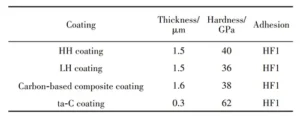
The tool coatings employed were HH coating, LH coating, carbon-based composite coating, and ta-C coating, with their properties detailed in Table 1.
The HH coating, LH coating, and carbon-based composite coating were prepared using high-power pulse magnetron sputtering (HiPIMS) technology, while the ta-C coating was produced via cathode arc technology.
To investigate the friction and wear behavior between aluminum alloys and different coatings, we deposited various coatings onto the surface of carbide plates measuring 16 mm × 16 mm.
We then measured the coefficient of friction using a friction and wear testing machine.
Testing and Characterization
The friction coefficient of uncoated and coated cemented carbide inserts was tested using a ball-on-disc friction tester.
The counter-partner used was a 6063 aluminum alloy ball, with a rotational speed of 500 r/min, a load of 1 N, and a test duration of 15 min.
Scanning electron microscopy (SEM, JSM-6701F, JEOL Ltd., Japan) was employed to examine the wear scar morphology on the aluminum ball surface and the cutting edge morphology of the micro-drill and milling cutter after machining.
The adhesion strength between the coating and substrate was evaluated using the indentation method, with a test load of 588 N and a load-holding time of 8 s.
Bond strength grades were evaluated according to the VDI 3198 (1991) standard, where HF1 corresponds to the strongest bond and HF6 to the weakest bond .
Drilling tests were conducted using a German-made Schmoll drilling machine.
Micro-drill test parameters included a rotational speed of 155 kr/min, feed rate of 40 mm/s, and a drilling limit of 10,000 holes.
Test substrates were aluminum alloy plates (0.8 mm thick). The milling test equipment was a Viga dual-axis milling machine, with aluminum substrate plates (1.2 mm thick) as the test material.
We used a DSX 510 deep-field microscope (OLYMPUS, Japan) to examine the surface wear patterns on the cemented carbide inserts.
We also analyzed the cutting edges and spiral flute geometries of the micro-drill and milling tools.
In addition, we observed the hole-entry morphology of the drilled holes.
An optical microscope was used to examine burr formation along the edges of the aluminum substrate.
Results and Discussion
Effect of Different Coatings on the Friction Properties of Aluminum Alloy
1. Coefficient of Friction
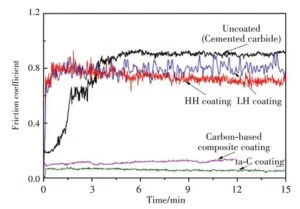
Figure 2 illustrates the influence of different coatings on the friction coefficient of aluminum alloy.
As shown, the lowest friction coefficient occurs between aluminum alloy and ta-C coating, approximately 0.07, while the friction coefficient with carbon-based composite coating is about 0.18.
Higher friction coefficients are observed between aluminum alloy and HH coating, LH coating, and the highest friction coefficient of approximately 0.89 is recorded with the cemented carbide substrate.
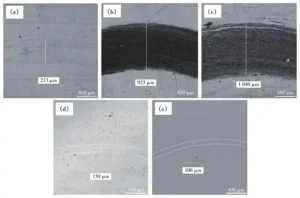
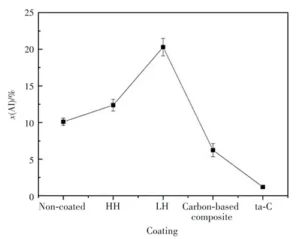
Figure 3 displays the morphology and width of wear scars after counter-friction between different coatings and aluminum alloy, while Figure 4 shows the aluminum content in the wear scars of various coatings.
The figure indicates that the LH coating exhibits the widest surface wear scar, approximately 1046 μm, with a relatively high aluminum content of 20.29% atomic fraction.
This result indicates that under ball-on-disc friction test conditions, aluminum alloy removed from the counterface readily adheres to the LH coating surface.
The hard alloy surface exhibited a scratch width of 513 μm and an aluminum atomic fraction of 10.1%, suggesting its lower affinity for aluminum compared to the LH coating, primarily due to the relatively stable chemical properties of WC .
The ta-C coating exhibited the narrowest scratch width at 106 μm and the lowest aluminum atomic fraction of 1.2% within the scratches.
This indicates extremely low affinity between the ta-C coating and aluminum alloy, which is advantageous for mitigating aluminum adhesion on cutting edges during machining.
different coatings: (a) uncoated (cemented carbide);
(b) HH coating; (c) LH coating,; (d) carbon-based
composite coating; (e) ta-C coating
2. Wear of Aluminum Alloy Balls
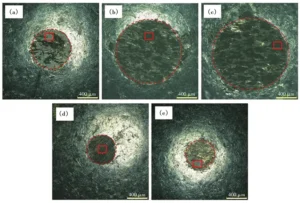
Figure 5 shows the surface wear scar morphology of aluminum alloy balls after counter-grinding with different coatings.
The figure reveals that after friction and wear testing, near-circular wear scars of varying sizes formed on the counter-grinding surfaces of the aluminum alloy balls.
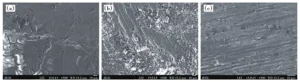
Combined with the SEM images in Figure 6 showing surface wear patterns of aluminum alloy balls after counter-grinding with cemented carbide, LH coating, and ta-C coating, it can be observed:
The uncoated cemented carbide surface formed a dense and continuous “transfer film”.
The “transfer film” on the aluminum alloy ball surface counter-ground with LH coating was discontinuous, exhibiting an island-like distribution.
The morphology of the “transfer film” on the aluminum alloy ball surface after grinding with the ta-C coating is similar to that of the LH coating, exhibiting an island-like, discontinuous distribution.
According to the energy dispersive spectroscopy (EDS) results from the grinding scar region (the test area indicated by the rectangular box in Figure 5).
Table 2 shows that the grinding debris in the wear scars formed by aluminum alloy balls sliding against cemented carbide, the HH coating, and the LH coating primarily consists of aluminum and oxygen.
No elements from the coating or cemented carbide substrate were detected. In addition to aluminum and oxygen, carbon elements were also detected in the carbon-based composite coating and ta-C coating.
Based on oxygen content results, the aluminum alloy ball worn against the LH coating exhibited higher oxygen levels, indicating significant oxidation of aluminum during high-speed rotational testing.
In contrast, the aluminum alloy ball worn against the cemented carbide coating showed relatively lower oxygen content, suggesting less oxidation of aluminum.
Significant carbon was detected in the wear marks of aluminum alloy balls ground against ta-C coatings, indicating that a graphite transfer film formed on the surfaces of the aluminum alloy grinding pairs under friction heat during the test.
The presence of this graphite transfer film partially prevented direct contact between the coating and the aluminum alloy, resulting in the lowest coefficient of friction.
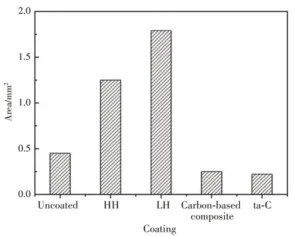
Figure 7 shows the wear mark areas on the surfaces of aluminum alloy balls after grinding against different coatings.
The figure reveals that the aluminum alloy ball exhibited the smallest wear scar area (0.22 mm²) after friction with the ta-C coating.
This occurred primarily because the graphite transfer film reduced the friction coefficient between the contact pairs.
It also prevented direct contact between the aluminum alloy and the coating.
As a result, the aluminum alloy caused only minimal wear on the coating.
The aluminum alloy ball exhibited the largest wear scar area (1.79 mm²) after friction with the LH coating.
This resulted primarily from the discontinuous surface structure of the aluminum alloy and its oxide film.
The high-hardness coating material continuously frictioned against the aluminum alloy, leading to substantial material removal from the friction pair.
In contrast, the wear scar area of aluminum alloy balls after counter-grinding with cemented carbide was 0.45 mm², smaller than those after counter-grinding with LH and HH coatings.
This is mainly because the wear scar surface of the counter-grinding pair was covered by continuous aluminum alloy and its oxides, preventing direct interaction between cemented carbide and aluminum alloy.
The oxides possess relatively high hardness and are difficult to wear away, resulting in a smaller wear scar area.
Aluminum Alloy Drilling Process
1. Surface Topography of Coated Micro-Drills
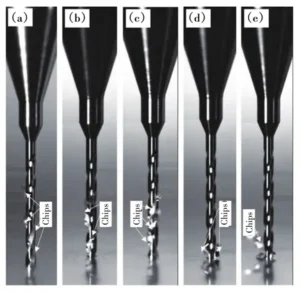
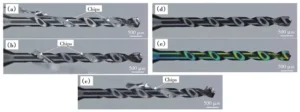
Figures 8 and 9 respectively show the chip ejection patterns of micro-drills with different coatings during micro-hole drilling of aluminum alloy plates, and the topography of the 10,000-hole slot regions machined by micro-drills with different coatings.
The figures reveal that during machining, aluminum chips clearly adhere to the spiral flutes of uncoated microdrills, HH-coated microdrills, and LH-coated microdrills.
In contrast, carbon-based composite-coated microdrills and ta-C-coated microdrills exhibit smooth chip evacuation from the spiral flutes as drilling depth increases, with no chip adhesion observed.
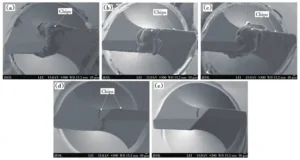
Figure 10 shows the drill tip morphology of different coated microdrills after machining 10,000 holes in aluminum alloy plate.
The image reveals significant aluminum chip adhesion on the drill tips and primary cutting edges of the uncoated microdrill, HH-coated microdrill, and LH-coated microdrill, with relatively large amounts of adhesion.
The aluminum chip adhesion on the carbon-based composite coating surface is significantly reduced.
In particular, ta-C-coated micro-drills exhibit only a small amount of aluminum chips at the drill tip.
No aluminum chip adhesion is observed on the main cutting edge.
The primary reason for these phenomena is that the substrate of the uncoated microdrill is cemented carbide.
According to friction and wear test results, aluminum adhesion occurs on the surface of cemented carbide.
Consequently, aluminum chips are difficult to evacuate during machining and adhere to the drill tip, main cutting edge, and flutes under the influence of cutting heat.
For HH-coated and LH-coated micro drills, aluminum alloy also tends to adhere to the coating surface during high-speed cutting, leading to severe aluminum chip adhesion on the cutting edges.
In contrast, for carbon-based composite-coated and ta-C-coated micro drills, the carbon elements on the surface form a graphite lubrication layer under cutting heat during high-speed machining, accelerating chip evacuation.
Since the ta-C coating is a pure carbon coating with stable chemical properties, it demonstrates superior effectiveness in suppressing aluminum chip adhesion.
2. Micro-drill Surface Burrs
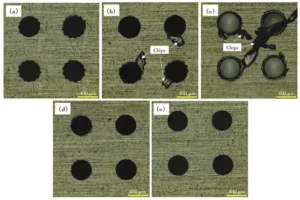
Figure 11 shows the hole morphology in the drilling direction after 10,000 holes were drilled into an aluminum alloy plate using micro-drills with different coatings.
The figure shows varying degrees of burrs on the hole edges after drilling with uncoated micro-drills, HH-coated micro-drills, and LH-coated micro-drills.
HH-coated and LH-coated micro-drills even left uncut aluminum chips after drilling.
This is primarily due to aluminum adhesion on the cutting edges, which dulls the sharpness and prevents clean separation of the generated chips.
After drilling with carbon-based composite-coated microdrills, the hole edges in the drill entry direction exhibited slight burrs.
In contrast, the holes produced by ta-C-coated micro drills exhibited smooth, burr-free edges.
This superior performance stems from the ta-C coating’s low friction coefficient, which inhibits aluminum chip adhesion to the cutting edge.
This ensures sustained edge sharpness, enabling clean chip separation and efficient evacuation through the flutes.
Consequently, burr formation at the hole exit is effectively suppressed.
3. Coated Microdrill Tool Life
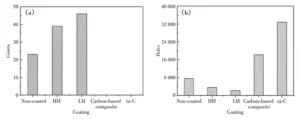
Figure 12(a) shows the number of broken microdrills when machining aluminum alloy plates with 10,000 holes using different coatings (50 tools tested).
The figure indicates that the LH-coated microdrill exhibited the highest breakage rate at 46 instances, while the uncoated microdrill recorded 23 breakages.
Both the carbon-based composite-coated and ta-C-coated microdrills processed 10,000 holes in aluminum alloy plates without breakage.
As shown in Figure 12(b), with increasing hole count limits, the carbon-based composite coated microdrill experienced its first breakage at 18,230 holes, while the ta-C coated microdrill broke for the first time at 32,800 holes.
For the LH coating, the first tool breakage occurred at 2,140 holes, while the uncoated microdrill reached 7,590 holes before the first breakage.
This primarily resulted from increased cutting forces due to wire entanglement and substantial aluminum chip adhesion on the cutting edges, leading to fracture upon reaching the carbide’s torsional limit.
As shown in Figure 9(c), the LH-coated microdrill exhibited the lowest initial breakage hole count due to significant aluminum chip accumulation on its drill tip, primary cutting edge, and spiral flutes.
During drilling with the ta-C coated micro drill, chip evacuation was smooth with no significant aluminum chip adhesion, resulting in the highest initial breakage life.
When the number of holes reached 32,800, increased cutting forces due to cutting edge wear led to breakage.
Milling of Aluminum Substrates
1. Cutter Groove Morphology
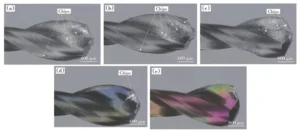
Figure 13 shows the groove morphology after milling 10 m of aluminum substrate using cutters with different coatings.
The images reveal that after machining 10 m of aluminum substrate, the uncoated cutter, HH-coated cutter, and LH-coated cutter exhibit significant aluminum chip adhesion within the flute and on the peripheral cutting edge.
The carbon-based composite-coated cutter shows moderate aluminum chip adhesion on the rake face, with no adhesion observed within the flute or on the peripheral cutting edge.
The ta-C-coated milling cutter exhibited minimal aluminum chips on its rake face, primarily due to slight coating wear after machining a certain length, exposing the carbide substrate that adhered to the aluminum chips.
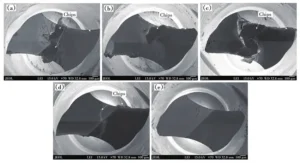
Figure 14 shows the tip morphology of different coated milling cutters after machining 10 m of aluminum substrate, with results consistent with those in Figure 13.
2. Edge Morphology After Milling
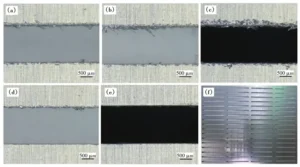
Figure 15 shows the groove surface morphology after milling 10 m of aluminum substrate using different coated milling cutters.
The image reveals significant burr formation on the grooves milled by the uncoated cutter, HH-coated cutter, and LH-coated cutter, with the LH-coated cutter exhibiting the most severe burring.
The burrs on the slot surfaces milled by the carbon-based composite coated milling cutter were slightly reduced but still noticeable.
The slot surface milled by the ta-C coated milling cutter showed no burrs, with straight slot edges.
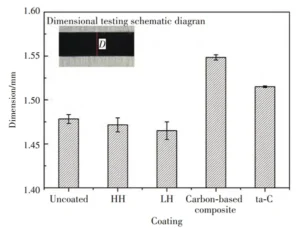
As shown in the groove width data in Figure 16, the ta-C coated milling cutter achieved a groove width of 1.515 mm, meeting the quality specification (1.5 mm ± 0.05 mm).
The carbon-based composite coated milling cutter produced a groove width of 1.548 mm, approaching the upper tolerance limit of the quality specification.
In contrast, the groove widths obtained by the uncoated milling cutter, HH-coated milling cutter, and LH-coated milling cutter were all less than 1.47 mm.
Although the mean values met the quality specification requirements, significant fluctuations were observed, rendering them unsuitable for practical application.
Conclusions
We systematically investigated the friction properties of HH coatings, LH coatings, carbon-based composite coatings, and hydrogen-free diamond-like (ta-C) coatings during aluminum alloy machining.
We also analyzed their chip evacuation behavior under high-speed cutting conditions.
In addition, we evaluated the quality metrics of the workpieces after mechanical drilling and forming.
The primary conclusions are as follows:
(1) When an aluminum alloy ball ground against different coatings, the ta-C coating exhibited the lowest coefficient of friction (approximately 0.07), with only trace amounts of aluminum present in the grinding marks.
This indicates that the ta-C coating effectively suppresses aluminum adhesion.
In contrast, the coefficients of friction for the cemented carbide, HH coating, and LH coating all exceeded 0.6.
The grinding marks also contained significant amounts of aluminum.
These results indicate that these materials failed to effectively suppress aluminum adhesion.
(2) During drilling of aluminum alloy plates, ta-C coated micro-drills exhibited almost no aluminum chip adhesion.
After drilling 10,000 holes, the surface remained burr-free, with a maximum machining life reaching 32,800 holes.
Uncoated micro-drills, HH-coated micro-drills, and LH-coated micro-drills showed significant aluminum adhesion and produced substantial burrs on the hole surfaces;
(3) During milling of aluminum substrates, ta-C coated milling cutters exhibited only minor aluminum chip adhesion.
After machining 10 meters, slot surfaces remained burr-free with stable dimensional accuracy meeting quality specifications.