
The manufacturing sector is currently undergoing a dual transformation driven by the “deepening of globalized operations” and the “iteration of intelligent technologies.”
Quality competitiveness has become the key lever for enterprises to break through global market barriers and avoid homogenized competition.
However, in the process of globalization, quality control in manufacturing faces three major structural challenges:
Core Challenges in Global Quality Contro
First, low efficiency in quality inspection—traditional manual inspection struggles to adapt to large-scale production across multiple sites, resulting in high rates of missed and misjudged defects;
Second, cross-border quality coordination is slow, with quality data across global R&D, production, and supply chain segments being fragmented, leading to delays in issue tracing and response;
Third, standard adaptation is difficult, as quality standards and technical specifications vary significantly across different countries and regions, resulting in high compliance costs.
Research Progress and the Emergence of Quality 4.0
Many studies have focused on the integration of intelligent technologies with global supply chain quality, forming a research framework of “technology empowerment—mechanism optimization—practical validation.”
The Quality 4.0 concept has emerged as the core of this research, with scholars identifying its key characteristics—real-time monitoring, defect prediction, and end-to-end intelligent control—through systematic reviews.
Empirical research by McKinsey indicates that AI-enabled solutions can reduce supply chain defect rates by 50%.
Empirical Findings and Industry Application Dynamics
At the application level, a two-stage model developed by Tan et al. reveals a coordination paradox regarding AI inspection technology between suppliers and buyers, noting that technology sharing may lead to insufficient investment incentives;
A Rockwell Automation report indicates that 50% of global manufacturers plan to adopt AI/machine learning (ML) as a core tool for quality improvement by 2025, with defect detection and compliance assurance emerging as primary application scenarios.
International Standards Integration and Research Expansion
Additionally, collaborative research on international standards focuses on optimizing the alignment between the International Organization for Standardization (ISO) framework and Industry 4.0 technologies, forming an integrated “standards-technology-industry” research framework.
Some studies closely align with the strategy to build a quality powerhouse, exhibiting distinct characteristics of “policy orientation—pain point targeting—practical innovation.”
Research focuses on three major areas: first, the localized application of intelligent inspection technologies, developing distributed quality control systems for multi-site production scenarios;
Second, cross-border quality collaboration mechanisms, conducting research on standard mutual recognition and data interoperability around the Belt and Road Initiative to build a full-lifecycle traceability system;
Third, quality system innovation in specific industries, such as the construction of a five-dimensional quality assurance model—covering “people, machinery, materials, methods, and environment”—based on GB/T standards in the prefabricated construction sector.
SME Transformation and Future Research Directions
Meanwhile, cost-sharing for the intelligent transformation of small and medium-sized enterprises (SMEs) and the widespread adoption of technology have become research hotspots, leading to solutions such as the “AaaS service model” and “empowerment by core enterprises.”
However, further research is needed on cutting-edge issues such as cross-border data security collaboration and the competition for influence in international standards.
AI-Driven Paradigm Shift in Quality Management
It is evident that AI technology, with its capabilities in data processing, intelligent decision-making, and cross-domain collaboration, is reshaping the underlying logic of quality management and control.
Specifically, by integrating AI, the Internet of Things (IoT), big data, and other technologies, to drive the entire process of quality planning, control, coordination, and improvement toward digitalization, automation, intelligent transformation, thereby realizing a new paradigm of quality control characterized by comprehensive sensing (Sense), intelligent prediction (Predict), precise intervention (Act), collaborative control (Control), and continuous evolution (Evolve).
This has become the key engine for resolving the challenges of global quality management.
The Core Mechanisms of AI-Empowered Intelligent Quality Transformation in Manufacturing
Efficiency Improvement Mechanism:Overcoming Quality Inspection Bottlenecks
The essence of the AI-empowered efficiency improvement mechanism in quality inspection lies in the practical implementation of the “end-to-end control” philosophy of Total Quality Management (TQM) and the theory of Data-Driven Decision Making (DDDM). TQM emphasizes that quality control must span the entire production chain, shifting from “post-event correction” to “end-to-end prevention.”
AI technology, by establishing a closed-loop system of “data collection—model training—intelligent decision-making,” effectively overcomes the operational limitations of traditional TQM in terms of real-time responsiveness and precision.
AI Closed-Loop System and Technical Implementation
From a technical perspective, Hisense’s AI vision inspection system—with its 0.1-millimeter precision positioning and “simultaneous imaging and inspection” capability—aligns with the core requirements of DDDM theory: “data immediacy—analytical accuracy —decision effectiveness.”
By using machine vision sensors to collect quality data non-destructively and in real time, and then training deep learning models [such as Convolutional Neural Networks (CNNs)] to convert inspection rules into algorithmic models, the system replaces subjective human judgment, thereby overcoming the physiological limitations and efficiency bottlenecks of traditional manual inspection.
Industrial Practice and Performance Improvement
In Hisense’s implementation, AI machine vision has reduced the inspection time per unit to under 5 seconds and increased the defect detection rate to 98%, directly embodying the “conversion of data value into efficiency value” principle of the DDDM theory.
Knowledge Management and Continuous Quality Optimization
At the same time, the construction of the Quality Intelligence System adheres to Knowledge Management (KM) theory, consolidating expert experience into digital assets through knowledge graphs to achieve the codification, reuse, and iterative optimization of quality management knowledge.
This process aligns with the core principle of “continuous improvement” in TQM. By using AI models to perform real-time analysis of process parameters and inspection data across global production sites, it automatically identifies quality anomaly patterns, driving the transformation of quality control from “post-event tracing” to “pre-event prediction.”
From Prevention Principle to Intelligent Execution System
Essentially, this converts the “prevention principle” of TQM into an actionable execution system through intelligent technology.
Collaborative Empowerment Mechanism: Breaking Down Cross-Border Quality Barriers
At the core of the AI-driven cross-border quality collaboration mechanism lies the deepened application of Supply Chain Collaboration (SCC) theory and network organization theory in the context of globalized production.
SCC theory emphasizes that all nodes in the supply chain must achieve optimal overall efficiency through information sharing and process coordination, while the fragmentation of cross-border quality data essentially stems from issues of “information asymmetry” and “standard incompatibility” within supply chain collaboration.
By building a global quality data platform, AI technology integrates data across the entire chain—including R&D, production, logistics, and after-sales—through unified data standards and interfaces.
This directly addresses the core challenge of “information coordination” in SCC theory: the data hub serves as a coordination center, transforming global production bases into “interconnected nodes” within a network organization, enabling real-time flow and sharing of quality information.
This aligns perfectly with the characteristics of “decentralized coordination and complementary resource integration” in network organization theory.
Furthermore, the multilingual and cross-time-zone adaptability of AI collaboration tools further reduces the “transaction costs” of cross-border collaboration, making “joint analysis and collaborative resolution” of multi-party, cross-regional quality issues possible.
Hisense’s “data sharing, problem-solving together” system, built upon its Quality Management System (QMS), validates the core value of AI technology in cross-border quality collaboration—namely, “reducing transaction costs and enhancing collaborative efficiency.”
This drives the transformation of global quality control from “decentralized management” to “networked collaboration,” enabling real-time, coordinated resolution of quality issues across global production bases.
Standard Adaptation Mechanism: Facilitating International Compliance
The core function of international standards is to “harmonize technical differences and reduce transaction costs,” but the diversity and dynamic nature of standards leave enterprises facing the dilemma of “excessively high harmonization costs.”
The “standard knowledge base—intelligent matching—dynamic updating” system built by AI essentially reduces standard coordination costs through technological means: leveraging large language models to integrate international standards such as ISO and the International Automotive Task Force (IATF), as well as national technical specifications, it forms an intelligent adaptation engine.
This aligns with the core logic of “standard integration and compatibility” in standard economics—that is, achieving digital parsing and automatic matching of standard rules through algorithms, thereby shifting enterprises from “passive adaptation” to “proactive response.”
At the same time, the validation processes of AI tools (algorithm reliability testing, false negative rate calibration) meet the “compliance requirements” for the application of intelligent technologies in standards, embodying the core concept of Dynamic Capability Theory (DCV) that “enterprises adapt to changes in the external environment through dynamic adjustment of capabilities.”
That is, the dynamic iteration of international quality standards requires enterprises to possess rapid adaptation capabilities.
The “real-time update” feature of the AI adaptation engine enables enterprises to dynamically respond to changes in standards, thereby reducing compliance costs while enhancing adaptation efficiency.
This mechanism not only validates the feasibility of the principle in standards economics that “technology empowers the implementation of standards,” but also strengthens enterprises’ dynamic capabilities to address changes in international regulations through AI technology, achieving the dual objectives of “compliance” and “efficiency.”
Practical Approaches to AI-Driven Intelligent Quality Transformation in Manufacturing
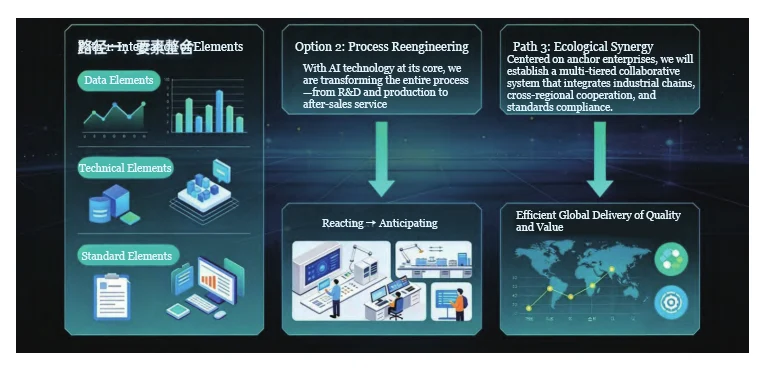
The core logic behind AI-driven intelligent quality transformation in manufacturing is “factors as the foundation, processes as the core, and ecosystem as the wings.”
These three approaches mutually reinforce one another and build upon each other, forming a comprehensive transformation system.
Through quality management innovations characterized by direct user engagement, intelligent drive, and value symbiosis, this approach facilitates a fundamental shift from scale advantages to quality advantages, and from cost leadership to experience leadership.
Path 1: “Element Integration to Build a Global
AI+SPACE-Driven Quality Intelligence Element System”
Element integration is the foundation of the transition to quality intelligence.
It requires the global unification and efficient allocation of three core elements: data, technology, and standards. Hisense’s practice provides a typical model for this path.
1. Integration of Quality Data Elements
Building a Globally Unified Data Hub: Data serves as the foundational bedrock for AI transformation and application.
The integration of data elements is the source that ensures AI agents can efficiently and accurately acquire and process data, thereby driving business innovation in the era of intelligence.
The integration of quality data elements requires the establishment of a global quality data hub covering R&D, production, testing, and after-sales services, which breaks down cross-border data silos through unified data standards and interfaces.
Within its overall AI architecture, Hisense prioritizes data governance and has embedded data quality into its strategic framework.
First, the company integrates multi-source data—including process parameters, inspection images, and after-sales feedback—from global production bases to form a standardized data asset repository.
Second, the company deploys the Xinghai large model and user needs identification agents to transform user pain point data from over 160 countries and regions into inputs for quality improvement, synchronizing these insights across all production bases.
To ensure continuous data availability, a data quality control mechanism has been established. AI algorithms automatically cleanse and validate data, ensuring the consistency and reliability of cross-border data and providing unified data support for global quality decision-making.
2. Integration of Technological Elements: Building a Scenario-Based Intelligent Technology Matrix
In the AI era, the logic of improvement has shifted from a traditional process-driven approach to a goal- and scenario-driven model.
The integration of technological elements must focus on core quality control scenarios, combining technologies such as AI vision, digital twins, and big data analytics to form a comprehensive, end-to-end technical support system encompassing “perception—analysis—decision-making—execution.”
Hisense has deployed an AI vision inspection system covering comprehensive inspection scenarios such as component assembly and product appearance, implementing a cumulative total of 43 industry-first automated technologies.
Concurrently, the company has established an intelligent process design platform that trains models using over 100,000 process data points to automatically generate optimal process solutions.
Building upon this platform, Hisense has introduced digital twin technology to construct virtual replicas of its global factories, enabling the simulation of quality issues and process optimization.
3. Integration of Standard Elements: Establishing an Intelligent International Standards Adaptation Library
In the context of global expansion, relying on traditional experience-based judgment to meet the quality requirements of different countries and regions is costly and inefficient.
With the support of AI technology, building a dynamically updated library of international quality standards enables the full process of standard interpretation, matching, and implementation to be carried out intelligently.
Hisense integrates international standards such as ISO 9001 and IATF 16949, along with technical specifications from various countries, to form an intelligent knowledge base.
By leveraging large language models to develop standard interpretation tools, the company automatically converts complex standards into actionable quality inspection items and testing procedures.
Simultaneously, by embedding standard requirements into the AI-powered quality inspection system, the system automatically aligns testing procedures with compliance requirements.
For example, when addressing different market standards such as the EU’s CE certification and the U.S. UL certification, the system can automatically switch testing parameters to ensure product compliance.
Option 2: Process Reengineering to Achieve Intelligent Quality Upgrades Across the Entire Supply Chain
Process reengineering refers to the restructuring of the entire process—from R&D and production to after-sales service—with AI technology at its core, driving the transformation of quality control from a “reactive” approach to a “proactive” one.
1. Accurately Translating Quality Requirements During the R&D Phase
Traditional R&D models fall short in terms of end-to-end closed-loop management of requirements and often lack systematic, holistic planning for product quality.
By leveraging large AI models, companies can bridge the conversion chain between “user requirements—quality metrics—process parameters,” ensuring that product quality precisely aligns with global market demands.
Hisense’s Specific Approach:
(1) Using an agent platform based on large language models (LLMs) to analyze global user feedback and market standard data, transforming vague requirements (such as “clearer picture quality”) into specific quality metrics (such as resolution and color gamut values) and process parameters;
(2) Using AI algorithms to predict quality risks, identifying potential defects during the R&D phase and optimizing design solutions;
(3) Establishing a global R&D collaboration platform that uses AI tools to enable real-time sharing of quality data and design solutions among multi-regional R&D teams, reducing the time from user feedback to implementation of quality features in new products by 62%.
2. Implementing End-to-End Intelligent Control During the Production Phase
Production quality is a critical factor in ensuring product quality consistency and production efficiency.
A closed-loop production quality control system covering “intelligent design—intelligent inspection—real-time control” must integrate processes and data across multiple domains, including manufacturing, inspection, process control, and production collaboration.
In terms of intelligent process design, taking display product development as an example, AI models automatically generate optimal process solutions.
Digital models are used for matching and verification, replacing the traditional manual assembly verification of prototype samples, thereby shortening the process design and verification cycle by more than 30%.
Regarding intelligent inspection, AI vision inspection systems have been deployed in factories producing core products such as televisions and refrigerators to replace manual labor for high-precision inspection.
As a result, inspection efficiency in television factories has increased by 70.7%, with an inspection accuracy rate reaching 98%.
In real-time process control, AI analyzes equipment parameters and material data during production to automatically adjust process parameters and prevent quality defects.
For example, the automatic precision panel alignment system calibrates assembly accuracy in real time (±0.2 mm), ensuring product consistency.
In cross-border production collaboration, the global quality data platform enables real-time sharing of production quality data across all manufacturing sites, allowing headquarters to remotely monitor and guide sites in optimizing production quality.
3. Establishing a Closed-Loop Quality Improvement Process in the After-Sales Phase
To enable rapid tracing and continuous improvement of user-facing quality issues, it is essential to establish a seamless data link between after-sales and front-end operations.
First, use AI to analyze global after-sales feedback data to precisely identify quality weaknesses (such as heat dissipation issues in a specific product model).
Second, establish a mechanism for integrated analysis of after-sales and production data to trace the root causes of problems (such as deviations in process parameters or component quality issues).
Finally, rapidly iterate improvement plans across global manufacturing facilities to form a closed-loop management cycle of “after-sales feedback—root cause analysis—front-end improvements—effect verification.”
Path 3: Ecosystem Synergy—Building a Global Quality Collaboration Ecosystem
Ecosystem synergy refers to the establishment of a multi-tiered collaborative system centered on leading enterprises, integrating “industrial chains, cross-regional cooperation, and standards compliance” to facilitate the efficient transmission of quality value across global networks.
1. Quality Collaboration Across the Industrial Chain
Establish an open, intelligent quality platform to empower upstream and downstream enterprises to upgrade their quality standards, thereby fostering a collaborative and mutually beneficial quality ecosystem across the industrial chain.
Hisense’s initiatives include:
(1) Connecting over a thousand upstream and downstream enterprises via an industrial internet platform to share quality data and AI inspection tools; for example, opening up AI vision inspection standards and algorithms to component suppliers to guide them in optimizing production quality.
(2) Establishing a supplier quality rating system that uses AI to analyze supplier product quality data and dynamically adjust cooperation strategies.
(3) Providing digital transformation consulting services to help small and medium-sized suppliers build basic quality data management systems, driving the supply chain’s quality compliance rate to over 99.8%.
(4) Driving industrial upgrading and high-quality global expansion.
In the past two years, Hisense has facilitated investment and capacity expansion by 28 industrial chain enterprises in Shandong and supported over 30 suppliers in expanding overseas; Hisense’s business now spans 126 countries participating in the Belt and Road Initiative.
2. Cross-Regional Quality Collaboration
Establish a global quality collaboration center to break down regional barriers, unify quality standards, and enable rapid resolution of issues:
(1) Utilize the QMS to enable real-time sharing of quality data across six global production sites, reducing the resolution time for cross-border quality issues by 40%;
(2) Deploy multilingual AI collaboration tools to support real-time analysis and decision-making on quality issues by teams in different regions;
(3) Establish a global quality emergency response mechanism to address sudden quality issues (such as batch defects).
Using AI tools, rapidly coordinate across sites to implement measures such as recalls and corrective actions, thereby mitigating market risks.
3. Synergy Between Standards and Compliance
Collaborate with industry associations and standards bodies to build a platform for aligning with international quality standards, thereby reducing global compliance costs:
(1) Participate in the development of international standards, promote the implementation of standards related to AI quality technology, and enhance the industry’s influence;
(2) Utilize AI technology to develop standard mutual recognition tools, helping enterprises quickly adapt to quality standards in different countries and regions;
(3) Establish a dynamic compliance early-warning mechanism that uses AI to track updates to international standards and promptly alert enterprises to adjust their quality practices.
Based on these three key strategies, Hisense has achieved remarkable results in its intelligent quality transformation: three of its factories have been recognized as global “Lighthouse Factories”; the company has twice won the National Quality Award and received the First Prize of the China Quality Technology Award three times; it has twice been awarded the China Quality Award Nomination Prize and also won the Asian Quality Excellence Award; and its subsidiary, Sanyo Electric Holdings Co., Ltd. in Japan, has twice received the Japan Deming Prize, earning the trust and recognition of global users through its unparalleled quality.
Management Insights: A Dual-Pronged Approach Combining Corporate Implementation and Government Support
At the corporate level, companies should establish standardized data foundations and knowledge graphs.
They should develop compliance processes for cross-border data flows and adopt technologies such as data de-identification and encryption to ensure security; they should also establish globally unified data standards and quality control mechanisms to enhance data reliability;
Referencing ISO/IEC 27001:2022 “Information technology — Security techniques — Information security management systems — Requirements,” improve the compliance management of AI training data (e.g., compliance with labeling requirements and log retention).
Industry-Level Coordination: Cross-Border Data Governance Systems
At the industry level, a cross-border data governance and security assurance system must be established.
A “whitelist” system for cross-border data flows in the manufacturing sector should be implemented to streamline compliance approval processes; a data security classification and protection mechanism should be established, and emergency response plans for data breaches should be refined;
Promote international cooperation on cross-border data security and build a mutually recognized security assurance framework.
Government-Level Policy Support and Ecosystem Enablement
At the government level, refine policies supporting technological innovation.
Develop distinct support and incentive policies for leading enterprises, supply chain anchor enterprises, and platform enterprises.
Provide leading enterprises with specialized support for AI quality technology R&D to help build a globally unified quality data middle platform and intelligent collaboration system.
Support supply chain anchor enterprises in establishing open, industry-chain quality intelligence platforms to empower upstream and downstream enterprises to upgrade their quality standards; provide financial support for industry-chain collaborative quality improvement projects.
Support platform enterprises in establishing service platforms for the dynamic tracking and adaptation of international standards, providing precise compliance support.
Future Trends in AI-Driven Quality Transformation
In the future, with the continuous iteration of AI technology and the intelligent upgrading of international quality standards, the intelligent transformation of manufacturing quality will exhibit three major trends:
First, the deep integration of AI with technologies such as digital twins and 5G, achieving full-scenario coverage of quality control through “virtual simulation + physical execution”;
Second, the upgrading of cross-border quality collaboration toward “real-time and intelligent” operations, further enhancing global quality improvement efficiency;
Third, the deep integration of international quality standards with AI technology will form a new paradigm of quality control characterized by “data-driven + standard-led” approaches.