
With the rapid development of the manufacturing industry, CNC lathes are being used more and more widely in machining, particularly in the production of high-precision parts, where thread cutting technology plays a crucial role.
As a core component of fasteners, the machining quality of threads directly affects the performance and stability of the entire mechanical system.
During the thread cutting process, various factors—including machine accuracy, tool wear, and the selection of process parameters—often lead to machining errors.
These errors not only reduce thread precision and surface quality but may also affect the service life and safety of the parts.
How to effectively control errors in thread machining and improve machining precision and stability has become a critical issue in the field of mechanical processing.
Based on this, this paper investigates error control methods in thread cutting technology and analyzes their application effectiveness.
Overview of Thread Cutting Technology on CNC Lathes
Thread cutting technology on CNC lathes, as a modern machining technique that relies on CNC systems to control the lathe and thereby achieve high-precision thread machining, plays a crucial role in the field of mechanical processing.
Thread cutting technology is primarily used to manufacture various threaded fasteners, such as bolts and nuts.
CNC lathes use programs to precisely control the tool’s movement path and perform cutting operations according to predetermined thread parameters—such as pitch, thread angle, and thread diameter—thereby achieving high-precision and highly consistent thread machining.
During the thread machining process on a CNC lathe, the workpiece is rotated by the lathe spindle, while the tool moves linearly relative to the workpiece along a predetermined path.
By precisely controlling the feed rate of the tool and the spindle speed ratio, the CNC system ensures that the tool moves axially by one pitch length with each rotation of the workpiece, thereby forming the thread.
CNC lathes feature a high degree of automation and are simple to operate, effectively eliminating human errors associated with manual operations, and are particularly well-suited for mass production.
Compared to traditional manual lathes, the thread-cutting technology of CNC lathes offers higher machining efficiency and precision, making them particularly suitable for machining complex threads such as tapered threads, spherical threads, and multi-start threads.
CNC lathes can perform automatic compensation and precise positioning during the machining process, further enhancing thread surface quality and machining accuracy, making them one of the key technologies in modern mechanical manufacturing.
Analysis of Sources of Thread Machining Errors
Equipment Errors
Equipment malfunctions are one of the primary causes of thread machining errors during the manufacturing process.
These malfunctions primarily stem from unstable spindle speed, wear on the guideways, poor stability of the tool holder, and programming errors in the CNC system.
If the mechanical spindle speed cannot be maintained at a stable level, it will cause errors in the pitch of the helical threads, thereby compromising manufacturing quality.
Guideway wear can cause operational errors during machine operation.
Particularly after prolonged use, as wear on the guideways worsens, it affects the accuracy of tool positioning, resulting in an uneven helical surface during machining.
If the tool holder becomes unstable, the machine will struggle to maintain the pre-planned cutting path during the cutting process, which is likely to cause errors.
Code errors in the CNC system or deviations during data transmission can cause deviations in the thread cutting trajectory.
Therefore, during thread machining, it is essential to regularly inspect and maintain the equipment to ensure the precision of all lathe components, thereby minimizing the impact of equipment accuracy errors on the machining results.
Errors in Process Parameter Selection
The settings of the machining environment have a significant impact on the precision of thread cutting, and improper selection may lead to errors.
First, the selection of feed rate is critical to the accuracy of thread cutting.
An excessively high feed rate may accelerate tool wear, thereby affecting machining quality; a slower feed rate increases cutting resistance, leading to an increase in surface defects at the machined interface.
Second, inaccurate adjustment of feed settings can also cause errors in helical trajectory machining.
Excessively high feed rates can easily cause tool loads to exceed standard limits, leading to tool deformation or vibration that disrupts the accuracy of helical dimensions;
Insufficient feed rates may reduce machining efficiency and limit production output.
Furthermore, the machining depth must be strictly controlled. If the machining depth is set too deep, it may cause workpiece deformation or even tool damage;
If the machining depth is set too shallow, it may result in reduced machining quality or poor thread quality.
Therefore, in thread cutting operations, process parameters must be configured based on a comprehensive consideration of the workpiece characteristics, tool properties, and machine tool capabilities to ensure the accuracy and surface quality of the thread.
Tool Wear Errors
Tool wear is one of the primary factors causing deviations in the thread manufacturing process.
As the equipment performs cutting operations, the cutting edges of the cutting tools gradually wear down, reducing cutting efficiency and thereby affecting the quality of the threaded product.
First, tool wear directly affects the dimensional accuracy of the thread profile.
If the cutting edge becomes dull due to wear, additional forces may be generated during cutting, leading to issues such as increased surface roughness and distortion of the thread profile.
Second, cutting tool wear also affects the precision of the helical threads.
Especially during mass production, progressive equipment wear leads to deviations in helical pitch and width, reducing the fit of machined components.
Tool wear can also increase vibration amplitude, thereby amplifying machining deviations in the helical threads.
This vibration-induced deviation is particularly pronounced during deep machining or when working with hard materials.
To minimize errors caused by tool wear, tools must be replaced or reground regularly, and tool wear must be monitored in real time during thread machining to ensure machining accuracy.
Workpiece Material Variations
The material properties of the workpiece are a key factor determining the accuracy of the thread-cutting process.
Differences in the properties of various materials during cutting can lead to machining deviations.
First, in the initial stage, the hardness of the raw material significantly affects the thread cutting process.
Machining harder materials increases difficulty, as the cutting edge is more prone to wear or deformation, thereby affecting the precision and surface finish of the thread;
Moreover, harder materials are more susceptible to deformation, resulting in irregular spiral patterns.
Second, the tensile strength and hardness of the material also affect the outcome of the helical thread machining process.
During cutting, increased hardness may result in higher cutting resistance, accelerating tool wear and compromising machining quality; conversely, materials with lower tensile strength may fracture or break during the process, leading to surface defects on the helical threads.
Additionally, material defects can also cause machining errors. During the cutting process, material defects may disrupt the cutting path, resulting in insufficient dimensional accuracy of the threads or poor surface finish quality.
Therefore, before thread machining, the material properties must be thoroughly evaluated and selected to minimize their impact on machining precision.
Thread Cutting Error Control Technology
Precision Positioning and Automatic Compensation Technology
Precision positioning and automatic compensation technology is one of the key methods for controlling errors in thread machining.
During the thread cutting process, the relative positional accuracy between the workpiece and the cutting tool is critical;
Positioning errors directly affect the dimensional and geometric accuracy of the thread.
Modern CNC lathes, equipped with high-precision positioning systems that integrate servo motors and linear encoders, can achieve micron-level positioning accuracy.
The resolution of linear encoders can reach 0.1 μm, ensuring that the tool maintains a stable feed position throughout the machining process.
Automatic compensation technology within the CNC system enables real-time error correction by monitoring tool wear, temperature changes, and workpiece deformation.
In high-temperature machining environments, thermal deformation of the lathe can cause pitch errors.
The automatic compensation system uses signals from temperature sensors to automatically adjust tool position compensation, correcting errors caused by thermal expansion.
This real-time error compensation technology can control thread machining errors within 5 μm, significantly improving machining accuracy and consistency.
Tool Optimization and Monitoring
The condition of the cutting tool directly affects the precision of thread machining;
Therefore, tool optimization and real-time monitoring technologies have become essential methods for controlling thread machining errors.
First, the selection of tool material is critical; carbide or ceramic tools are typically used to enhance wear resistance and heat resistance.
Carbide tools can last up to five times longer than standard steel tools and maintain good cutting performance even in high-temperature environments.
Second, to extend tool life and ensure machining accuracy, CNC lathes are equipped with tool monitoring systems capable of real-time monitoring of tool wear.
By monitoring cutting forces, vibrations, and temperature changes, the system can predict the tool’s wear status and issue replacement warnings in advance.
For example, when cutting forces exceed 200 N or tool temperatures exceed 150°C, the system will automatically prompt the operator to replace or regrind the tool.
This tool monitoring technology effectively prevents machining errors caused by tool failure, maintaining thread machining accuracy within ±0.01 mm.
Optimization of Machining Parameters
In the thread-cutting process, selecting appropriate machining parameters is key to minimizing errors;
Optimizing cutting speed, feed rate, and depth of cut can effectively improve the quality of thread machining.
Taking the machining of the commonly used material 45 steel as an example, when the cutting speed is set to 100–150 m/min, the feed rate to 0.2–0.4 mm/r, and the depth of cut to 0.3–0.5 mm, it is possible to maintain good surface roughness and dimensional accuracy while ensuring machining efficiency;
However, if the cutting speed is increased to 200 m/min, the surface roughness Ra rises to 2.0 μm, and the error increases.
Experimental data show that selecting appropriate process parameters can control machining errors within ±0.02 mm.
Experiments and Results Analysis
Experimental Design
To verify the effectiveness of thread cutting error control technology, this paper carefully designed thread machining experiments under various combinations of process parameters.
The experiments were conducted using a CNC lathe for thread machining.
The workpiece material was selected as 45 steel, the cutting tool was a carbide threading tool, and a coolant was used for cooling.
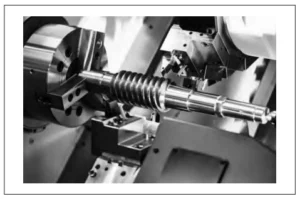
A schematic diagram of thread machining on a CNC lathe is shown in Figure 1.
The experimental variables include cutting speed, feed rate, and cutting depth, which will be set to different combinations to analyze their effects on thread machining errors.
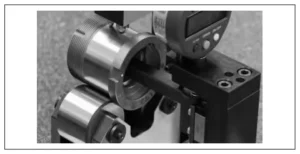
During the experiment, a linear encoder and a laser measuring system will be used to perform high-precision measurements on the machined threads, thereby evaluating their dimensional errors and surface roughness.
A schematic diagram of the thread measuring setup is shown in Figure 2.
To assess the impact of tool wear on machining quality, the condition of the tools was inspected every 100 workpieces during the experiment, and the wear patterns were recorded.
The experiment was divided into four groups, each using different process parameters and machining 50 workpieces to ensure the data was representative.
Additionally, the experimental protocol included monitoring of ambient temperature to ensure it remained within the range of (20±2)°C, thereby minimizing the impact of external temperature on the experimental results.
Experimental Results
In this experiment, the researchers measured the dimensional errors and surface roughness of the threads machined in each group and recorded the tool wear.
The experimental results for different process parameters are shown in Table 1.
As shown in Table 1, machining errors and surface roughness gradually increased with higher cutting speeds and feed rates.
At the same time, tool wear also increased with changes in process parameters; in particular, in Combination 4, which featured a high cutting speed, tool wear reached 15 μm.
表1
Results Analysis and Discussion
The experimental results indicate that process parameters have a significant impact on thread machining accuracy and surface quality.
Low cutting speeds and small feed rates help reduce machining errors and improve surface quality.
Under the conditions of a cutting speed of 100 m/min and a feed rate of 0.2 mm/r in Combination 1, the machining error was controlled within ±0.01 mm, with a surface roughness Ra of 1.0 μm, achieving high machining quality.
As the cutting speed increases, tool wear intensifies, which in turn affects thread machining accuracy.
In Combination 4, when the cutting speed reached 200 m/min, the machining error increased to ±0.025 mm, and the surface roughness also increased to 2.0 μm, indicating that high cutting speeds may be detrimental to maintaining machining accuracy.
The experimental results also show that tool wear is a significant factor affecting thread machining quality.
Particularly under conditions of high cutting speed and feed rate, accelerated tool wear significantly increases machining errors.
In actual production, selecting appropriate process parameters and promptly replacing tools are key measures to ensure thread machining accuracy.
Conclusion
This paper conducts an in-depth study of error control methods in thread cutting technology for CNC lathes, analyzing the effects of machine errors, process parameters, tool wear, and workpiece materials on machining accuracy.
Experiments have confirmed that appropriately selecting cutting speed, feed rate, and cutting depth, combined with tool wear monitoring and optimization, can reduce thread machining errors.
Automatic compensation and temperature control technologies play a significant role in high-precision thread machining, effectively reducing errors caused by thermal deformation and temperature fluctuations, thereby providing technical support for the process.