
In the SMT solder paste printing process, process engineers often focus on core parameters such as squeegee pressure, printing speed, release distance, and stencil thickness, yet they are prone to overlooking the critical factor of squeegee angle.
In fact, the squeegee angle directly determines the solder paste’s flow characteristics, filling capability, and print consistency.
As a fundamental parameter for controlling precision print quality and preventing batch defects, a thorough understanding of its principles is crucial for selecting production line processes and troubleshooting anomalies.
Definition and Principles of Squeegee Angle
Definition
The squeegee angle refers to the angle between the cutting edge of the squeegee blade and the plane of the stencil.
The standard angle range for mass production in the industry is 45° to 60°; in some special scenarios (such as printing specific sealing strips), a 90° right-angle squeegee may be used.
Principle
As the solder paste is sheared, rolled, and filled by the squeegee as it moves forward, different angles alter the ratio of the vertical downward force to the horizontal thrust, thereby directly affecting the solder paste’s penetration ability, rolling behavior, and the cleanliness of the stencil surface.
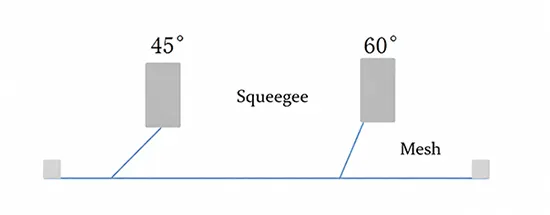
Comparison of Two Main Squeegee Angle Characteristics
A 45° squeegee angle is smaller, resulting in a larger contact area between the blade and the stencil.
It provides sufficient downward component force, ensuring even pressure on the solder paste, which effectively squeezes it into tiny stencil apertures and delivers excellent filling performance;
However, its scraping and cleaning capabilities are relatively weak, and a thin layer of solder paste tends to remain on the stencil surface.
A 60° squeegee angle is larger; the contact area along the cutting edge is narrower, and local pressure is concentrated, resulting in stronger scraping and cleaning capabilities on the stencil surface and enabling clean, residue-free printing.
However, the downward component of the force is lower, leading to insufficient filling capability for fine apertures, and prolonged mass production may accelerate wear on the stencil apertures.
Advantages, Disadvantages, and Applications of the 45° Squeegee
Key Advantages
Provides sufficient vertical downward pressure, ensuring full via filling for precision components such as fine-pitch BGAs, QFNs, CSPs, and LGAs, which significantly reduces defects such as insufficient solder and voids.
Pressure is distributed evenly without localized stress concentration, effectively preventing solder paste overflow and pin bridging issues, making it suitable for printing ultra-fine-pitch components with pin pitches of 0.3–0.4 mm or less.
High compatibility with thick stencils and large-diameter BGA pads, meeting the printing process requirements for various high-risk precision components specified in DFM guidelines.
Uniform pressure along the cutting edge minimizes stencil friction wear, effectively extending stencil service life and reducing fixture replacement costs.
Major Disadvantages
A thin layer of solder paste tends to remain on the stencil surface.
During continuous, high-frequency mass production, it is necessary to appropriately shorten the stencil wiping cycle and increase the frequency of equipment maintenance.
Under the same printing parameters, the overall solder deposit is relatively high, posing process risks such as solder overflow and solder bridging on large-area pads.
Standard Applications
Precision PCBs equipped with BGA, CPU sockets, 0.35/0.4 mm QFN, and LGA fine-pitch chips.
Ultra-thin precision circuit boards using 01005 and 0201 micro resistors and capacitors.
High-precision printing applications using 0.08–0.10 mm ultra-thin electroformed steel stencils and Type 5/Type 6 ultra-fine solder paste.
Production processes for SAC305 high-viscosity lead-free solder paste (viscosity > 200 Pa·s).
Precision motherboards requiring high reliability, such as those used in industrial control, automotive, and high-end consumer electronics.
Advantages, Disadvantages, and Applications of the 60° Squeegee
Key Advantages
Excellent cleaning performance leaves virtually no solder paste residue on the stencil surface.
Suitable for high-speed mass production, it significantly extends the interval between stencil cleanings and improves production efficiency.
It allows for controlled, lower solder paste deposition, effectively preventing defects such as solder overflow and bridging on standard large pads and connector pins.
The solder paste exhibits good flowability and stable printing performance, making it suitable for batch printing of large, contiguous PCB areas and long rows of connector pads.
Major Disadvantages
Insufficient vertical downward pressure results in inadequate filling of tiny apertures, leading to solder deficiency and pad voids in fine-pitch BGAs and high-density devices.
Localized pressure concentration at the cutting edge can cause wear and deformation of the stencil aperture walls during long-term mass production, affecting printing accuracy.
For fine-pitch components, increasing speed and pressure to compensate for solder volume can easily lead to secondary issues such as solder paste buildup on the bottom of the stencil and solder paste contamination.
Applicable Scenarios
Standard products such as standard-sized resistive and capacitive components (0402 and larger), standard connectors, and large-sized power supply pads.
General-purpose processes for Type 3/Type 4 standard solder paste and standard-thickness (0.12 mm and above) laser-cut stencils.
Standard consumer-grade motherboards with large surface areas and few precision components, suitable for high-speed, high-volume mass production lines.
Summary: For products emphasizing high density, fine pitch, and high reliability, be sure to select a 45° squeegee and strengthen stencil cleaning management;
If the product focuses on large components, high speed, and low cost, a 60° squeegee offers the best value for money.